Sinaia Monastery: Hours, What to See and the Royal Years
The town is named after it, and the king lived in it for twelve summers while Peleș was being built. It is open every day.
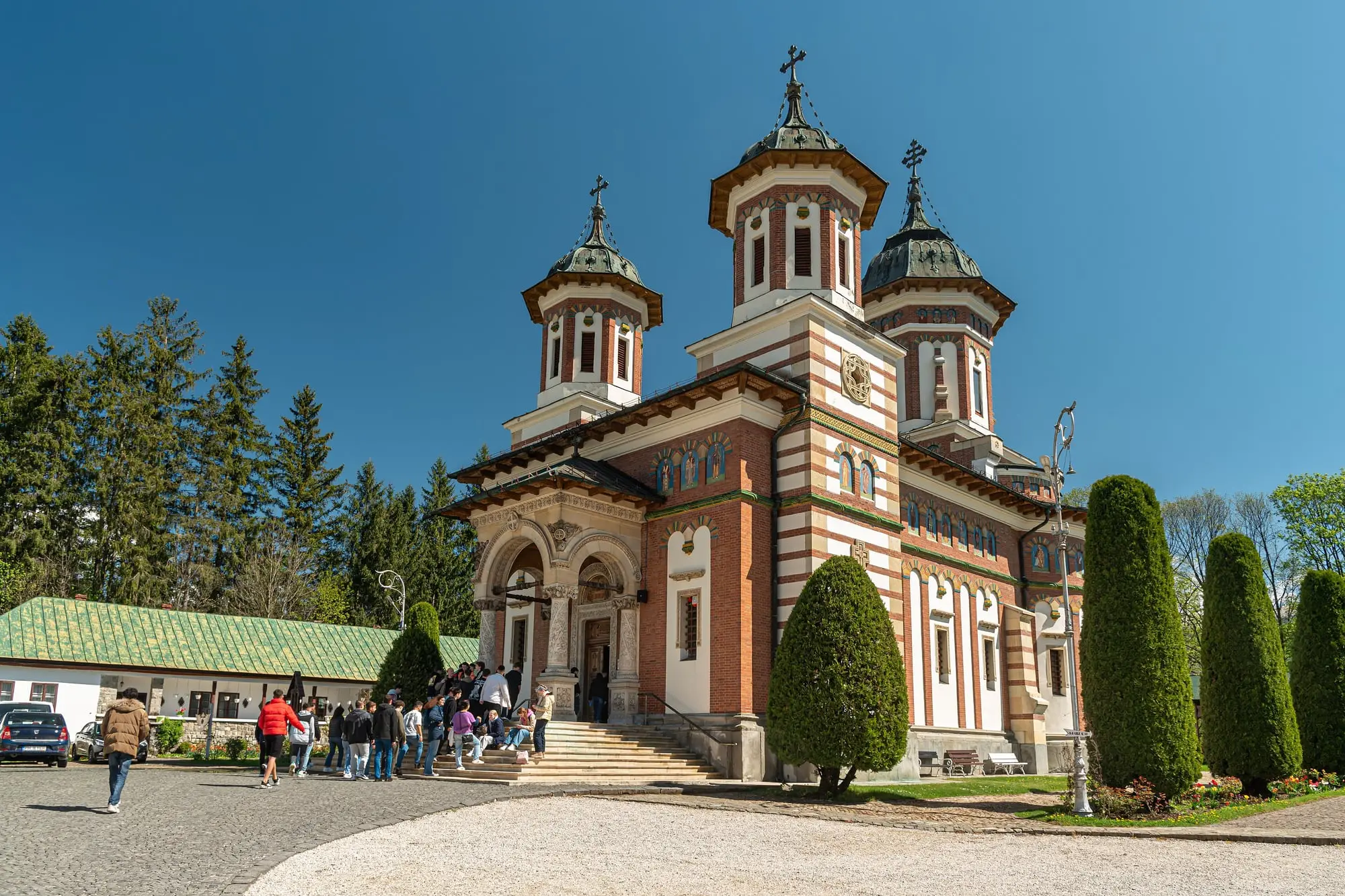
Sinaia Monastery is open to visitors every day between 8:00 and 20:00, according to its own website (Mănăstirea Sinaia, read on 15 November 2026). It stands at Str. Mănăstirii nr. 2, next to the royal park, and it is older than everything around it: the first church dates from 1695, almost two centuries before Peleș Castle.
In short
- Open daily, 8:00 to 20:00. Services are held morning, afternoon and evening.
- Two churches: the Old Church of 1695 and the Great Church, rebuilt in 1897–1903.
- A museum opened in 1892 in the rooms the royal family had used.
- The royal family lived here in the summers of 1871 to 1883.
- No entry fee is stated by the monastery or the national museum register.
When is Sinaia Monastery open?
The monastery gives one line for visitors: every day, between 8:00 and 20:00. It is a working monastery of monks, so the day is built around services, and the same page lists them.
| Time | Service |
|---|---|
| 8:00–10:00 | Morning services and the Liturgy |
| 16:00–17:00 | Afternoon service and Vespers |
| 18:45–20:15 | Evening services |
| Sundays and major feasts | 9:00–11:30 |
The museum keeps its own hours. The national register of museums, run by the National Heritage Institute and last updated on 9 November 2026, lists it as open 10:00 to 17:00 in summer and 10:00 to 15:00 in winter, on request (cIMeC museum guide). “On request” means that in winter you should ask at the monastery, or phone ahead on +40 244 314 917.
Neither source states an entry fee. Travel websites quote small sums for the museum, but none we found names where the figure comes from, so we leave it out.
What is there to see?
Two enclosures, built 150 years apart, joined end to end.
The old enclosure. Between 1690 and 1695, Mihail Cantacuzino built a monastery of stone and brick shaped like a small fortress, about 30 by 40 metres, with thick, high walls and cells along the inside. At its centre is the Old Church. The monastery describes its plan, a Latin cross on the outside, as unique in Romania.
The Old Church. The paintings in the porch are largely the originals, by Pârvu Mutu, the Cantacuzino family’s preferred painter. The founder’s portrait shows him with eighteen children and both of his wives. The church was burned in 1791, during a war, and partly repainted in 1795.
The Great Church. Built in a first, plainer form in 1842–1846, it was remade between 1897 and 1903 by the architect George Mandrea, who combined the Brâncovenesc and Moldavian styles. It is 30 metres long, 15 wide and over 25 high. The interior was painted by the Danish artist Aage Exner, in matt oil on a gilded ground that imitates mosaic.
The bell tower. Added in 1892, 15 metres high. Its bell weighs 1,700 kg and came from Colțea Monastery in Bucharest, another Cantacuzino foundation.
The tomb of Take Ionescu. Next to the chapel lies the statesman Take Ionescu, born in Ploiești in 1858, who died in Rome in 1922. The crypt was arranged in 1923, with frescoes by Costin Petrescu and passages from his speeches in parliament around the walls.
All of this is from the monastery’s own pages on its history and its Old Church.
What links the monastery to Peleș Castle?
The royal family lived here first. In the summers of 1871 to 1883 they occupied two buildings of the new enclosure. The monastery’s account is that Prince Carol, taken with the surroundings, and with a doctor recommending mountain air for Princess Elisabeth, decided to build Peleș Castle close by (monastery museum page).
The dates fit those of the castle. The museum at Peleș records that the estate was bought in 1871, that building ran 1873–1914, and that the castle served as a royal residence from 1883: the year the summers at the monastery end. Our history page has that side of the story.
The king and queen are still inside the Great Church. Exner painted them in the entrance hall: King Carol I beside a chipped stone column, which the monastery explains as a symbol of a kingdom not yet whole, and Queen Elisabeth beside Princess Maria, her only child, who died very young. Two Russian icons in the same hall were a gift from Tsar Nicholas II in 1903. The monastery also records that the church was given electric light in 1906.
What is in the museum?
When the royal family moved up to the castle, their former rooms were opened to the public as a museum, in 1892 according to the monastery’s most recent information. It calls itself one of the first religious museums in the country, open without interruption since. The building itself dates from 1847 and began as a guest house for travellers on the road over the mountains.
The pieces the monastery singles out:
- The Bucharest Bible of 1688. One of the few surviving copies of the first complete Bible in Romanian, printed under Prince Șerban Cantacuzino, the founder’s brother.
- An icon of the Holy Trinity by Pârvu Mutu, painted in 1693 and never restored.
- Icons made in Moscow in 1702–1703 and others painted around 1720 by Patriarch Sylvester of Antioch.
- A gilded silver Gospel cover of 1911 and a silver model of Curtea de Argeș Monastery, given in 1898.
- Embroidered vestments worked in gold and silver thread.
The national register counts almost 600 objects and 350 old books.
Is anything being restored?
Possibly, so expect scaffolding. The monastery’s notices page lists two contracts signed in January 2025: one to restore the old enclosure and one financing the restoration of the Great Church, followed in May 2025 by tenders for site supervision. The notices do not say which parts are closed or for how long, and we have not confirmed the state of the works. The phone number above is the way to check before a visit planned around the interiors.
How do you fit it into a day in Sinaia?
The monastery is in the town, beside the royal park, and the monastery’s site describes Peleș Castle as its immediate neighbour. Three things make it easy to add.
| Peleș Castle | Sinaia Monastery | |
|---|---|---|
| Open | Wednesday 10:00–17:00 · Thursday to Sunday 9:15–17:00 | Daily, 8:00–20:00 |
| Closed | Monday and Tuesday | No closed day stated |
| Entry | Timed ticket, 100 RON | No timed ticket |
It opens before the first castle slot and stays open four hours after the last entry at Peleș, so it fits at either end of the day. On a Monday or Tuesday, when both castles are shut, it is still open. Dress and behave as you would in any church in use: services take place three times a day.
For the rest of the town, see the Sinaia page and our article on Sinaia Casino.
Sources
- Mănăstirea Sinaia, official website: visiting hours and services, history, museum, Old Church and notices. Read on 15 November 2026.
- National Heritage Institute, cIMeC museum guide, “Sinaia Orthodox Monastery Museum Collection”, updated 9 November 2026: museum hours, holdings, address. Read on 15 November 2026.
- Peleș National Museum, history of Peleș Castle and visiting schedule: castle dates, hours and prices. Read on 14 November 2026.
Questions people ask
What are the opening hours of Sinaia Monastery?
The monastery's own website says it welcomes visitors every day between 8:00 and 20:00. The museum has shorter hours: the national museum register lists 10:00 to 17:00 in summer, and 10:00 to 15:00 in winter on request.
Is there an entrance fee for Sinaia Monastery?
Neither the monastery's website nor the national museum register states a fee, so we do not print one. Older travel pages quote a few lei for the museum without a source. The monastery's phone number is +40 244 314 917.
Why is the town called Sinaia?
Because of the monastery. Its founder, Mihail Cantacuzino, built it between 1690 and 1695 and named it after the Monastery of Saint Catherine on Mount Sinai, which he had visited in 1681.
How is Sinaia Monastery connected to Peleș Castle?
The royal family spent the summers of 1871 to 1883 in two buildings of the monastery. According to the monastery, it was there that Prince Carol decided to build Peleș Castle nearby. The former royal rooms became the museum.
Is Sinaia Monastery open on Mondays, when Peleș is closed?
The monastery's website gives the same visiting hours for every day, 8:00 to 20:00. Peleș and Pelișor are closed on Mondays and Tuesdays, so the monastery is one of the places in Sinaia you can still enter on those days.